|
Overview |
Scroll |
In the course of designing a product with symmetrical elements, it may be necessary to create objects that are a mirror image or a symmetric insert of an already modeled part of the product. KOMPAS-3D allows you to obtain such objects by reflecting the existing ones.
|
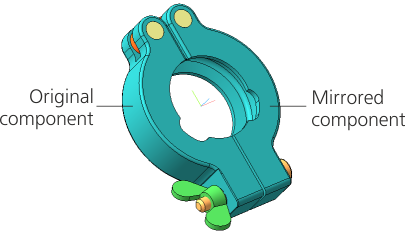
Model containing a mirrored component
Symmetry is a property of a geometric object, which consists in the fact that with some transformations one part of the geometric object coincides with the other part of it.
A geometric object is symmetrical relative to a plane, if for each point of the geometric object there exists another point of the same object, which is symmetrical relative to that plane. A geometric object may have several planes of symmetry as well.
If a geometric object coincides with itself when turning at any angle around a certain axis, then such an object is called axisymmetric. The simplest 3D shape with an axis of symmetry is cylinder.
A geometric object has a center of symmetry, if any straight line going through a certain point of this object is an axis of symmetry. In other words, a geometric object can be rotated at any angle relative to any straight line going through the center of symmetry. A sphere has such symmetry.
To create mirrored and symmetrical components, use the Mirroring Components  command. It allows you to create components that are mirrored and/or symmetrical to the original ones. This does not take into account operations on components performed in the assembly model containing them, i.e. the resulting components are a mirrored reflection of the models available in the source files of the original components.
The simulated part of the product may contain components with or without symmetry, as well as components whose symmetry is partially broken by the presence of projections, depressions, chamfers, etc. Depending on the presence of symmetry, the components are divided into:
•symmetrical,
•asymmetrical,
•conditionally symmetrical.
When choosing how to obtain components of the symmetrical part of the product, the presence of symmetry of the original components, as well as the requirements for optimizing the composition of the product, are taken into account.
The basic principles of adding components in various ways are described in detail in section Basic principles of mirrored and symmetrical arrangement of components.
To preserve the position of the added component relative to the original one and the specified symmetry plane, matings are automatically overlaid during mirroring (see section Automatic overlaying of matings when creating a component by mirroring).