|
Direction and angle of revolution |
Scroll |
To construct a revolution element, it is necessary to determine the direction of revolution and the angle to which the section will be revolved.
Revolution can be performed in one direction and in two opposite directions. For each direction, you need to select a method for determining the revolution angle and set the parameters corresponding to the selected method.
The desired method is selected using the Method group of buttons. The following options are available:
 By angle,
 To object.
More details on methods for determining the angle of revolution...
To construct in one direction, the choice of method and the setting of the corresponding parameters are performed in the Main section of the Parameter Panel. If you want to revolve a section in two directions, then set the Second direction toggle switch in position I (on) and set the desired parameters for the second direction.
The parameters set for the second direction may differ from the parameters set for the first.
The arrow on the phantom shows the first revolution direction.
If necessary, you can reverse the first revolution direction. To that end, in the Main section of the Parameters panel, click the Change direction button to the right of the Angle field (for the To Angle method) or Object (for the To object method).
If the By angle method is chosen for the first direction, then you can perform a symmetrical construction. To do this, in the Main section of the Parameter Panel, set the Symmetrically toggle switch to the I (enabled) position. Setting the second direction becomes unavailable. In the Angle field, the total revolution angle is entered. The construction will be performed symmetrically in both directions from the section.
|
For each of the directions, both positive and negative angle of revolution can be specified. The negative angle is counted in the opposite direction of the positive. This enables creation of an element separated from the section when rotating in two directions (see the figure). For proper construction, the values must not be equal in magnitude. |

|
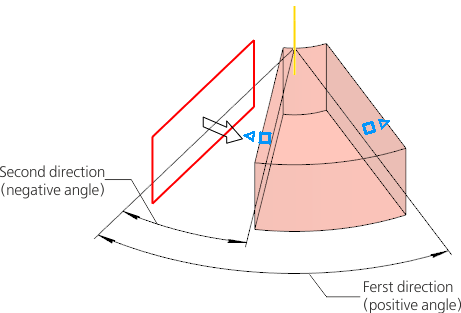
An example of revolution in two directions: a positive angle is specified for the first direction, and a negative angle for the second