|
Determination of the Flat Pattern Length Using the Position Coefficient of the Neutral Layer |
Scroll |
The flat pattern length is determined based on the assumption that the bend has a neutral layer.
Neutral layer is a layer in the material of a body, the length of which does not change when bent.
The intersection line of the bend neutral layer with the plane perpendicular to the bend line is called the neutral line.
|
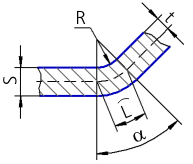
Bend section with a plane perpendicular to the bend line
(neutral line shown as dashed)
The flat pattern length of the cylindrical part of the bend is given as the length of a neutral line in it:
L = \u03c0 \u00b7 (R + K \u00b7 S) \u00b7 (\u03b1\/180), where
L is the neutral line length;
R is the inner bend radius;
S is sheet material thickness;
K is the position coefficient of the neutral layer;
α is the bend angle.
The coefficient K defines the position of the neutral layer:
K = t/S, where
t is the distance from the internal bend surface to the neutral layer.
The value of the coefficient K is user-defined.