|
Overview |
Scroll |
A linear surface by curve and surface is created by moving a segment, with the start vertex of the segment lying on the selected curve and the end vertex positioned in the section plane such that the segment forms a specified angle with the projection onto this plane of the normal to the surface passing through the intersection point of the plane with the curve.
The figure below demonstrates a variant of a linear surface, in which a reference curve is part of a base surface.
|
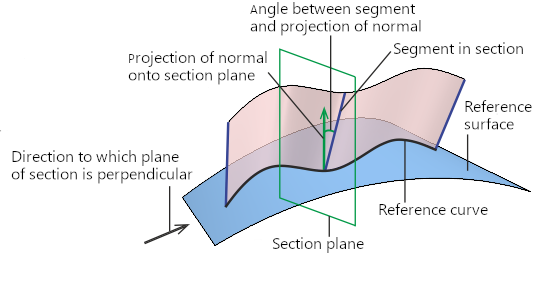
Drawing scheme for linear surface by curve and surface.
The reference curve here is located in the base surface.
Linear surface may be also plotted, if a reference curve is not located in a base surface.
The angle between a segment and the projection of the normal onto the section plane, as well as the length of the segment, may be constant or vary according to a given law.
The plane of the section in each of its positions is perpendicular to the specified straight-line direction or curve.
The figures demonstrate examples of linear surfaces plotted by a curve and a surface. The linear surfaces are marked by blue color.
|
|
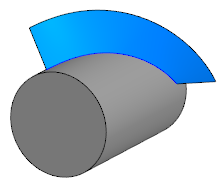
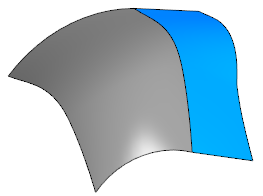
Linear surfaces plotted by a curve and a surface
The reference curve belongs to the base surface.
See Also