|
Parametric representation of the surface. Isoperimetric curves |
Scroll |
Surface is described in the model file as a geometrical locus of points whose coordinates are determined by functions of two parameters U and V:
x = x(U; V),
y = y(U, V),
z = z(U; V),
where U and V parameters are limited by limit values Umin ≤ U ≤ Umax, Vmin ≤ V ≤ Vmax.
Such description of the surface is its parametric representation.
Parametric region of the surface is the set of values of the parameters U and V, represented as a flat rectangular area. The surface is a display of this segment in the three-dimensional space of the model. Each pair of the parameters U and V values corresponds to a certain point on the surface. In particular cases, the surface can be defined by analytic functions of the parameters U and V. Such surfaces are called analytic. Analytic surfaces include, for example, flat, cylindrical, conical, spherical, torus, and other surfaces. A surface that is not defined by analytic functions is not considered analytic. Such surfaces include, for example, spline surfaces.
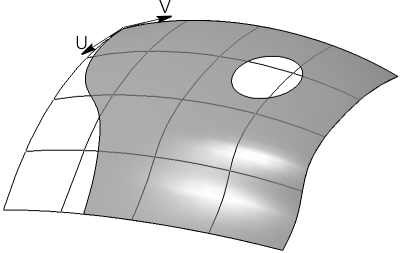
If one of the U or V parameter values is fixed, while the other is changed, then we get a curve lying on the surface. Such curve is called isoparametric. The curves obtained by changing the parameter U with the fixed parameter V are considered to be U direction isoparametric curves, while the curves obtained by changing the parameter V with the fixed parameter U are considered to be V direction isoparametric curves. The curves in both directions form an isoparametric grid, which allows to see the theoretical surface corresponding to the selected face in the graphical area of the document. Usually five curves of each direction are shown corresponding to values of 0, 25, 50, 75, 100 of U or V parameters (see figure). For example, the isoparametric grid is displayed when plotting a point using the On Surface.
Boundaries of the theoretical surface do not necessarily coincide with the contour of the facet, but the facet is always within the boundaries of its theoretical surface. Besides, the theoretical surface, as opposed to the facet, has no holes.
|