|
Overview |
Scroll |
Mechanical connection mating provides association between the movements of components in models of mechanical gears, gearboxes, cam mechanisms and others. The use of mechanical connection matings allows the projected mechanism to be transferred to different positions by moving one of its components. Moving this component drives the other components associated with it (subject to the constraints imposed by the positioning matings).
|
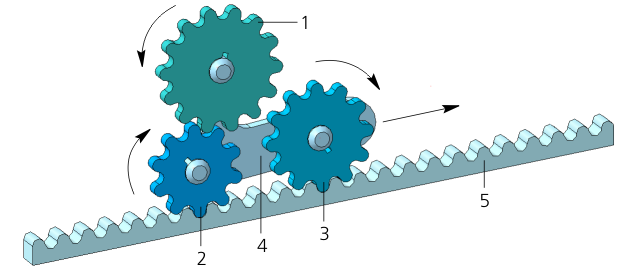
An example of connection of movements between parts
When creating matings, consider the following.
•Mechanical connection matings, as well as positioning matings, are overlaid on pairs of objects. The following types of mechanical connection matings and the corresponding types of movements are possible:
•Rotation – Rotation.Both objects are rotating.
•Rotation – Movement. One object rotates, the other moves along a straight-line path.
•Cam-pusher.One object (the cam) rotates, the other (the pusher) moves along a straight-line path while maintaining contact between the cam and the pusher.
•A model can have multiple mechanical connection matings. The same component can be connected by mechanical connection matings with multiple components.
In the example shown in the figure, as the wheel 3 moves along the lath 5, wheels 1 and 2 rotate. This is ensured by Rotation – Movement matings, applied to wheel 3 – lath 5, wheel 2 – lath 5, and by Rotation – Rotation mating, applied to wheels 1 and 2.
To view the work of a complex mechanism, if the task is not to show the movement of all its links, it suffices to specify the matings between the initial and final moving elements. In the example shown in the figure, this could be a mating Rotation – displacement, overlaid on wheel 1 and part 5. When part 5 moves, wheel 1 rotates, while wheels 2 and 3 do not rotate.
|
To create mates Rotation – rotation, Rotation – movement and to view their work there is no need in contact of the parts with each other. |

•When demonstrating mechanical gears, the positioning matings used in the model detailing limit the movement of components in space. Positioning matings should be imposed so that the components have the degrees of freedom necessary for the subsequent imposition of mechanical connection matings and their operation. Details...
See Also